.webp)
The Hidden Bottleneck of Waterpark Simulator: How Cleanliness, Maintenance, and Staff Allocation Control Park Growth
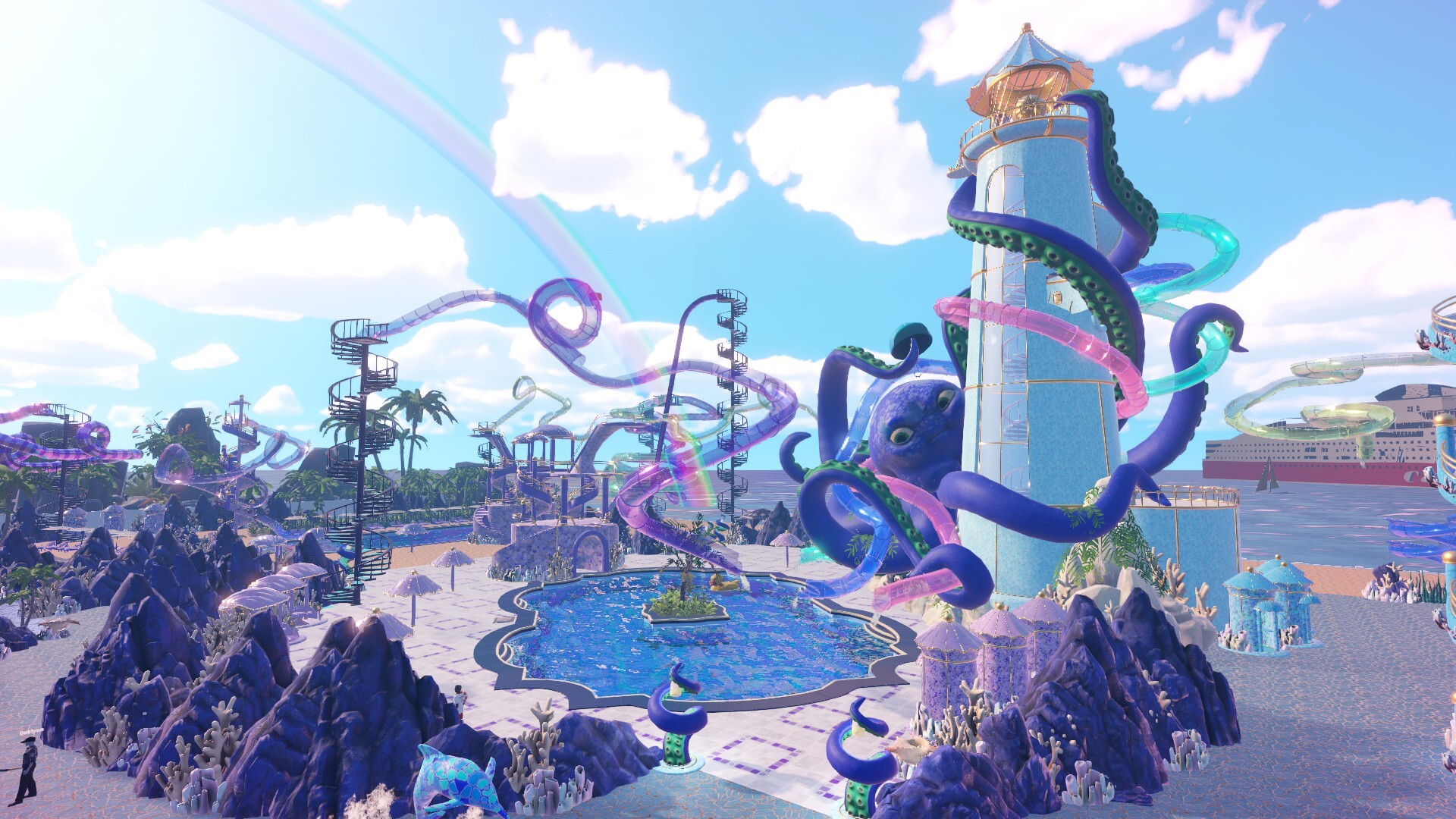
Waterpark Simulator looks like a game about building increasingly ridiculous water slides, attracting guests, and turning a small pool into a successful entertainment business. Yet its most interesting management problem is much narrower: keeping the park operational while guest activity continuously creates maintenance and cleanliness demands.
The game places the player directly inside the operation rather than separating management from physical work. You can sell tickets, serve food, clean messes, repair broken attractions, rescue guests, and eventually hire staff to take over parts of that workload. The official Steam description specifically emphasizes this hands-on loop, including cleaning, repairs, guest rescue, food service, and maintaining attractions.
That design creates a surprisingly important question: when should you stop doing everything yourself and start building a staff-supported operation? Hiring employees is not simply an upgrade. It changes how the entire park functions, because every additional attraction creates more opportunities for breakdowns, hygiene problems, restocking requirements, and guest dissatisfaction.
This article focuses specifically on that problem. Rather than discussing Waterpark Simulator as a general management game, the discussion follows the development of one operational issue over time: how a park can become too large for its owner to maintain manually, why cleanliness and durability become increasingly important, and how staff allocation changes from a convenience into a requirement for sustainable expansion.
The First Stage: When Doing Everything Yourself Actually Works
The opening stage of Waterpark Simulator encourages a very direct relationship between the player and the park. You are not initially standing in an office watching statistics. You are physically involved in the daily operation. Selling tickets, preparing food, cleaning, fixing attractions, and responding to problems are all part of the game's intended hands-on experience.
This works particularly well when the park is small because the number of simultaneous problems remains manageable. If a dirty area appears, the player can deal with it immediately. If an attraction requires attention, the player can walk over and handle it. There is little need to think about delegation when there are only a few tasks competing for attention.
The important lesson is that manual labor initially feels efficient because the park's workload is small, not because manual management is inherently scalable.
The Small-Park Illusion
A small waterpark creates an illusion of control.
The player can usually see most important areas quickly. There are fewer attractions to monitor and fewer guests creating problems simultaneously. A short walk can solve an issue before it becomes serious.
This makes early expansion tempting. If the player can personally handle everything, why hire staff immediately?
That question becomes increasingly important because the answer changes as soon as the park starts generating enough activity to produce overlapping problems.
The First Signs of Overload
The transition does not necessarily happen through one dramatic failure.
Instead, the player may notice that:
- One attraction needs attention while another is already becoming dirty.
- Guests require service while maintenance is waiting.
- Food-related tasks interrupt cleaning.
- A problem is discovered later than it should have been.
- Multiple tasks begin competing for the player's time.
This is the first indication that player attention itself is a limited resource.
Why Cleanliness Is More Important Than It First Appears
Cleanliness in Waterpark Simulator is not merely cosmetic decoration. The game's official description states that park performance and overall rating are influenced by cleanliness alongside fun, food, and amenities.
That makes hygiene an operational statistic rather than a visual detail.
A player can build impressive attractions, but if the surrounding environment deteriorates, the park's overall quality can suffer. This creates an important relationship between expansion and maintenance: every additional attraction can increase the area that must remain presentable.
Cleanliness Creates Recurring Work
Construction is usually a one-time decision.
Cleaning is different.
A new attraction can be built once and then continue generating guests. Those guests, however, continuously interact with the environment. Water, food, trash, and the general chaos of a busy park create recurring maintenance demands.
That means the real cost of an attraction is not necessarily limited to its purchase or construction cost.
There is also a maintenance workload.
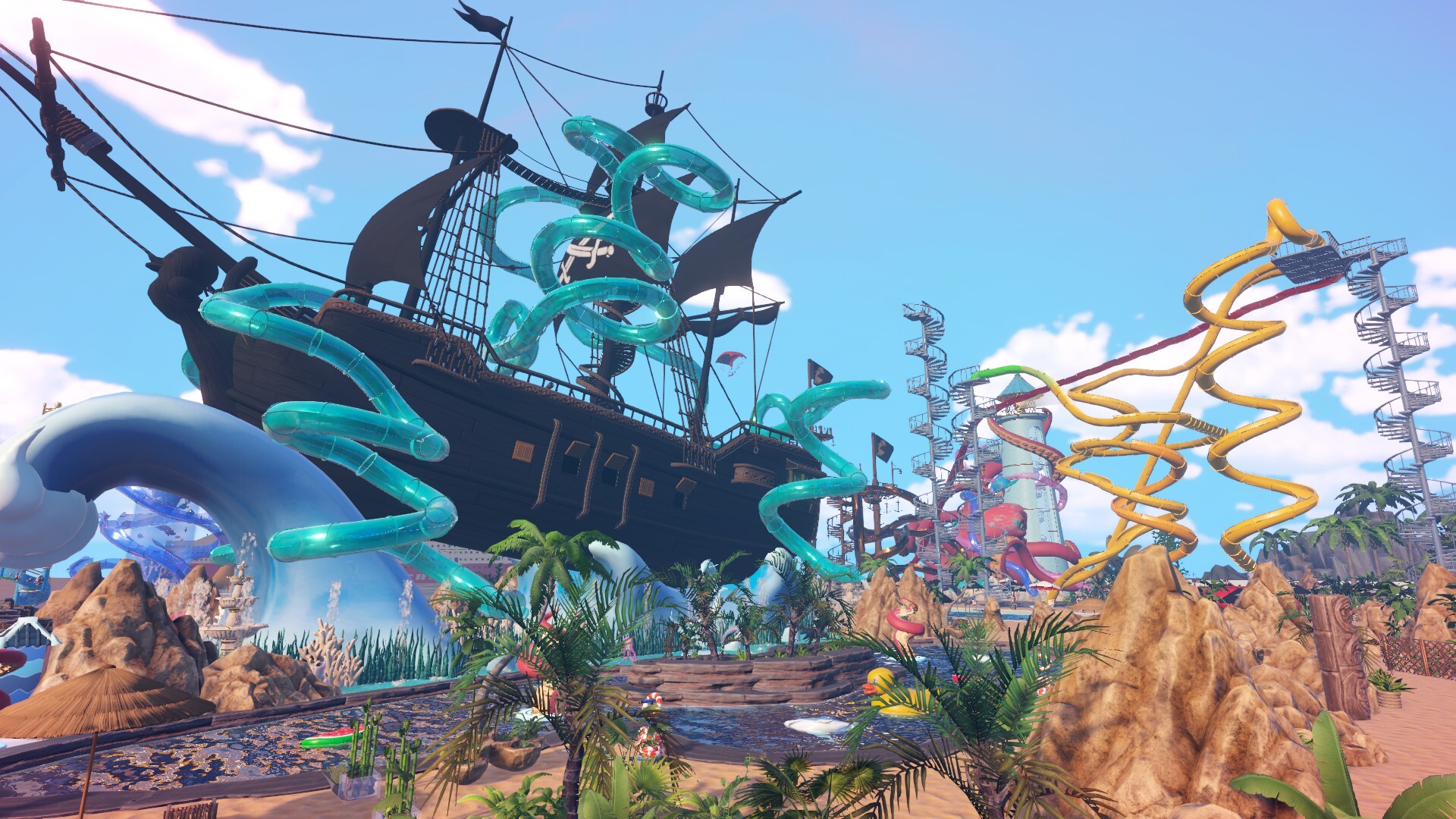
The Difference Between Building and Operating
This distinction is critical.
Building a larger park increases potential revenue and entertainment value.
Operating a larger park increases the number of things that must be monitored.
A player who thinks only about construction may therefore expand too quickly.
The park becomes larger faster than the player's ability to maintain it.
The Second Stage: Durability Turns Attractions Into Recurring Obligations
Waterpark Simulator also incorporates attraction durability and maintenance. The game's early patch history shows that developers specifically adjusted durability and cleanliness management to avoid overwhelming new players, while later interface improvements added information about Safety, Hygiene, Durability, and trash capacity.
This is significant because it reveals how the game's operational model is intended to work: attractions are not simply permanent objects that generate money forever.
They have ongoing requirements.
Every Attraction Has a Maintenance Shadow
Consider what happens when a new attraction is introduced.
The obvious benefit is additional entertainment.
But behind that benefit are several hidden questions:
- Who checks it?
- Who repairs it?
- Who responds when it stops functioning properly?
- How much attention does it require compared with other attractions?
- Can the player personally keep up?
The attraction therefore creates what can be called a maintenance shadow.
The bigger the attraction network becomes, the larger that shadow becomes.
Durability Changes Expansion Decisions
A financially successful park can still become operationally inefficient if the player keeps adding attractions without considering maintenance.
This produces an interesting management principle:
Revenue capacity should not be expanded faster than maintenance capacity.
That principle is easy to overlook because new attractions are visually exciting. Maintenance infrastructure is much less glamorous.
Yet it determines whether the park can actually sustain its new scale.
The Critical Transition: When One Player Is No Longer Enough
Eventually, the player reaches a point where multitasking stops being efficient.
This is the most important stage of the management loop.
The issue is not that the player lacks the ability to perform tasks. The issue is that too many tasks are competing for the same player-controlled worker.
The Attention Bottleneck
Imagine a park where four things happen at roughly the same time:
A slide needs attention.
A dirty area requires cleaning.
A guest needs assistance.
A food-related task needs to be handled.
The player can only physically address one problem at a time.
Even if each individual task is easy, the combined workload creates a queue.
That queue is the real bottleneck.
Why Queues of Problems Matter
A maintenance queue is different from a normal guest queue.
Guests waiting for a slide may tolerate some delay.
A maintenance problem can potentially affect the attraction itself.
A hygiene problem can influence guest satisfaction and park rating.
A service interruption can create additional work.
Therefore, unresolved tasks can produce secondary consequences.
The player is no longer simply completing jobs.
The player is managing the accumulation of jobs.
Hiring Staff Is Not Just an Upgrade
The solution is to delegate.
Waterpark Simulator explicitly allows players to hire staff as their parks grow, with the stated purpose of handling the daily chaos while the player focuses on the broader park.
This makes staffing a structural transition rather than a simple numerical upgrade.
Before hiring staff, the player is the primary operational workforce.
After hiring staff, the player becomes increasingly responsible for deciding what should be delegated and what should remain under direct control.
Delegation Changes the Player's Role
The player gradually moves through three stages.
First:
Worker
You clean, repair, serve, rescue, and manage.
Second:
Supervisor
You still intervene personally but rely on staff for routine responsibilities.
Third:
Operator
You concentrate on expansion, attraction design, finances, and strategic decisions while employees handle much of the recurring workload.
This progression is one of the most important structural changes in the game.
The Goal Is Not Maximum Staffing
Hiring everyone immediately would also undermine the economic challenge.
Staff have to justify their cost through increased operational capacity.
The ideal staffing level is therefore not:
“Hire as many employees as possible.”
It is:
“Hire enough employees that recurring operational problems stop consuming valuable player attention.”
That is a much more interesting optimization problem.
The Third Stage: Staff Speed and Task Coverage Matter
The importance of staffing becomes even clearer when considering how employees move around the park.
One early patch specifically increased staff movement speed and improved staff restocking behavior.
This is important because staff effectiveness is not simply determined by whether an employee exists.
Their effectiveness also depends on how quickly they can respond to tasks.
Distance Becomes an Operational Cost
A staff member located far from a problem has to travel.
That travel consumes time.
A badly organized park can therefore increase the practical workload of its employees.
This creates a connection between park layout and staffing efficiency.
A beautifully designed park may look excellent but still be operationally inefficient if essential services are scattered across large distances.
Staff Are Part of the Layout
Once staffing becomes important, the player should stop viewing employees as abstract upgrades.
They become part of the physical design.
The player should consider:
- Where problems are likely to occur.
- How far staff need to travel.
- Which attractions generate the most activity.
- Where food and service facilities are concentrated.
- Whether operational areas are separated or dispersed.
The park becomes a logistics problem.
Why Expansion Can Actually Make the Park Worse
Expansion is normally associated with improvement.
More space allows more attractions.
More attractions can increase guest interest.
More guests can generate more revenue.
But there is a hidden fourth step:
More guests create more operational workload.
The official game description explicitly links park growth with increasing popularity and the eventual need to hire staff to handle daily chaos.
That means expansion has a built-in management cost.
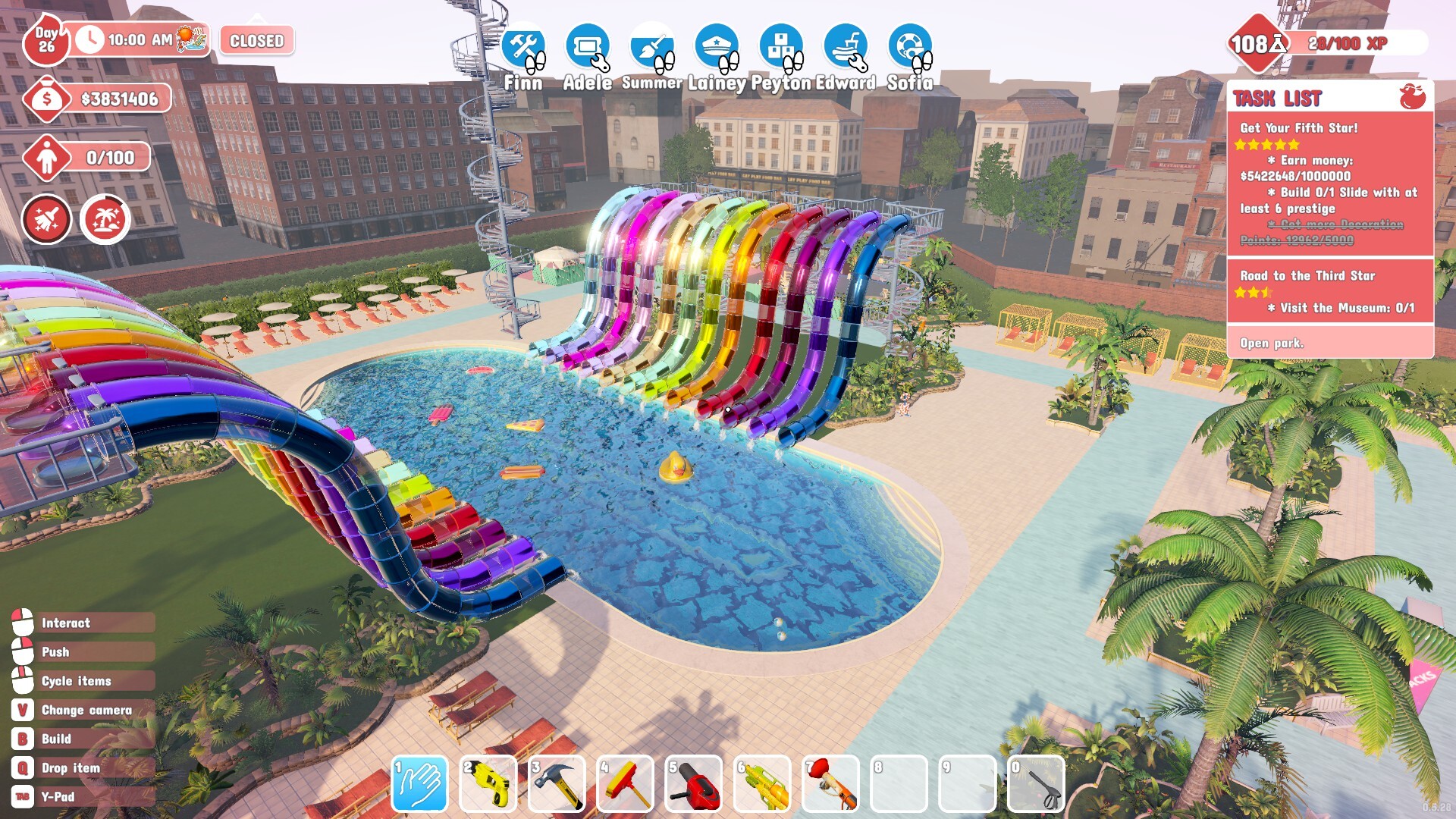
The Expansion Trap
A player can experience the following sequence:
Build attraction.
More guests arrive.
Revenue increases.
Build another attraction.
Guest volume increases again.
Maintenance requirements increase.
Cleanliness requires more attention.
The player becomes overwhelmed.
Guest satisfaction begins suffering.
The park is technically larger but operationally weaker.
This is the expansion trap.
Expansion Should Follow Operational Capacity
A more sustainable approach is to treat staffing and maintenance capacity as prerequisites for expansion.
Before adding another major attraction, ask:
Can the current workforce handle additional demand?
If the answer is no, expanding may temporarily increase revenue while creating a larger long-term problem.
Food Service Creates Another Layer of Competition
Waterpark Simulator also includes food stands and vending machines, with food quality contributing to guest happiness.
This introduces another recurring operational category.
Food is not simply an object that can be placed and forgotten.
It creates demand for restocking and service.
Why Food Competes With Maintenance
When the player is manually responsible for multiple systems, food can become another interruption.
A player who is repairing an attraction may have to switch tasks.
A player who is cleaning may have to respond elsewhere.
This creates what management games often call task fragmentation.
The problem is not necessarily the amount of work.
It is the frequency with which the player must switch between unrelated responsibilities.
Specialization Becomes Valuable
As the park grows, employees effectively allow the player to reduce task fragmentation.
Instead of constantly switching between:
Cleaning.
Repairing.
Restocking.
Serving.
The player can increasingly focus on high-value decisions.
That is where staff become strategically valuable.
Guest Satisfaction Is the Final Output of the System
The reason cleanliness, durability, staffing, and food matter is that they eventually converge on guest experience.
The game's official description states that happier guests stay longer, spend more, and are more likely to return, while overall park rating is influenced by factors such as cleanliness, fun, food quality, and amenities.
This creates a feedback loop.
The Positive Loop
A well-managed park can produce:
Good maintenance.
→ Better attraction availability.
→ Happier guests.
→ Better park performance.
→ More resources for expansion.
→ Greater operational capacity.
This is the ideal growth cycle.
The Negative Loop
The opposite can also happen:
Too much expansion.
→ Higher workload.
→ Delayed cleaning and repairs.
→ Lower guest satisfaction.
→ Reduced performance.
→ Less ability to improve operations.
The game therefore rewards sustainable expansion rather than expansion for its own sake.
The Fourth Stage: Designing Around Maintenance Instead of Attractions
Once the player understands the maintenance problem, park design changes.
The question is no longer simply:
“Where should I place the coolest slide?”
It becomes:
“How will this entire area function once hundreds of guests use it?”
Maintenance-Friendly Layouts
A practical park layout should make recurring work easy.
Consider creating zones:
- Attraction areas
- Food areas
- Pool areas
- Service paths
- Staff-accessible operational spaces
The goal is to reduce unnecessary movement.
H4: Compact Does Not Mean Crowded
There is an important distinction between compact design and overcrowded design.
Compact layouts can reduce travel distances.
Overcrowded layouts can create navigation and operational problems.
The ideal design minimizes unnecessary travel while preserving enough space for guests, attractions, and staff movement.
The Fifth Stage: Using Park Metrics as Diagnostic Tools
One of the most useful developments in Waterpark Simulator is the addition of clearer information about Safety, Hygiene, Durability, and trash capacity.
These statistics can be interpreted as diagnostic indicators.
Hygiene as a Warning Signal
If hygiene begins declining, the immediate response should not necessarily be to build another attraction.
The correct question is:
Why can't the current operation maintain cleanliness?
Possible causes include:
- Insufficient staff capacity
- Excessive guest concentration
- Poor operational layout
- Too much distance between problem areas and workers
Durability as a Maintenance Signal
Likewise, falling durability should trigger a maintenance review.
If attractions repeatedly require attention, the player should consider whether the current workforce can support additional expansion.
Statistics therefore become more useful when treated as signals of structural problems, not simply numbers to increase.
A Practical Staffing Philosophy for Growing Parks
The best staffing strategy is not based on a fixed number of workers.
It should be based on workload.
Stage One: Manual Operation
When the park is small:
- Perform most tasks yourself.
- Learn how different problems arise.
- Identify which responsibilities consume the most time.
This provides valuable operational knowledge.
Stage Two: Target the Biggest Time Sink
When the workload increases, hire staff for the task that consumes the largest amount of your attention.
Do not automatically distribute staffing evenly.
Instead, solve the biggest bottleneck first.
Stage Three: Remove Routine Work
As the park grows, staff should progressively absorb repetitive operational duties.
This frees the player to concentrate on:
- Expansion
- Attraction design
- Park layout
- Strategic improvements
- Guest experience
Stage Four: Expand Only When the System Is Stable
If hygiene, durability, and daily operations are consistently under control, expansion becomes safer.
This creates a simple principle:
Do not expand because you can. Expand because your operation can support it.
The Deeper Design Problem: Chaos Versus Control
Waterpark Simulator deliberately combines management with physical comedy.
The official description emphasizes its chaotic hands-on nature, including rescuing guests, repairing attractions, cleaning, and even dealing with absurd pool-related problems.
That chaos is part of the game's identity.
The challenge is making sure chaos remains entertaining rather than becoming repetitive administrative labor.
Why the System Works
The hands-on model makes the player feel responsible.
When something breaks, it is not simply a notification.
You can physically go and deal with it.
That creates immersion.
Why Delegation Matters
But the same immersion becomes exhausting if every problem remains the player's responsibility forever.
Staff therefore serve an important design purpose.
They allow the game to evolve from:
“I personally manage every problem.”
into:
“I created a system capable of managing problems without me.”
That transition is what gives the management layer meaning.
The Long-Term Solution: Build a Self-Sustaining Park
The strongest approach to Waterpark Simulator is not maximizing the number of attractions.
It is creating a park where operational problems can be absorbed without constant player intervention.
A self-sustaining park has several characteristics:
- Attractions remain operational.
- Hygiene stays manageable.
- Staff can reach problem areas efficiently.
- Food and other services remain available.
- Guest satisfaction remains strong.
- The player has enough free attention to plan expansion.
The Ultimate Measure of Success
The best park is not necessarily the biggest.
It is the park that continues functioning effectively while the player is busy doing something else.
That is the point where management finally becomes automation.
The player has created a system rather than simply performing a series of tasks.
Conclusion
Waterpark Simulator's most interesting management challenge is not the construction of giant slides or the visual customization of a park. It is the gradual transformation of operational workload into a problem of cleanliness, durability, staffing, and attention management.
At the beginning, doing everything personally makes sense. The park is small, problems are easy to reach, and the player can respond immediately. As the business expands, however, every new attraction introduces another source of recurring work. Guests create additional demands, attractions require maintenance, food needs service, and hygiene becomes increasingly important to the overall park rating.
Eventually, the player reaches the game's most important transition: manual labor must become delegation.
Hiring staff is therefore not merely an upgrade that makes the game easier. It represents a fundamental change in how the park is managed. The player stops being the person who solves every problem and becomes the person responsible for designing an operation capable of solving problems efficiently.
This also explains why expansion can be dangerous. A larger park is only an improvement when its maintenance capacity grows alongside it. Otherwise, more attractions simply produce more work, and more guests create more opportunities for cleanliness, durability, service, and satisfaction problems.
The most effective Waterpark Simulator strategy is consequently based on sustainable growth. Build attractions, but consider their maintenance burden. Increase guest capacity, but strengthen the staff structure supporting it. Improve the park's appearance, but do not neglect hygiene and durability. Most importantly, use the game's operational information to identify bottlenecks before expanding them.
The ultimate achievement is not simply owning the largest waterpark. It is creating a park that can handle its own chaos.
When the attractions keep working, the park remains clean, staff handle routine problems, guests stay satisfied, and the owner finally has time to think about the next expansion, the game's management loop reaches its most satisfying conclusion: you are no longer running every task in the waterpark—you are running the system that runs the waterpark.