.webp)
The Thermodynamics of Racing: Deconstructing Fuel Management and Weight Transfer Dynamics in Gas N Cars
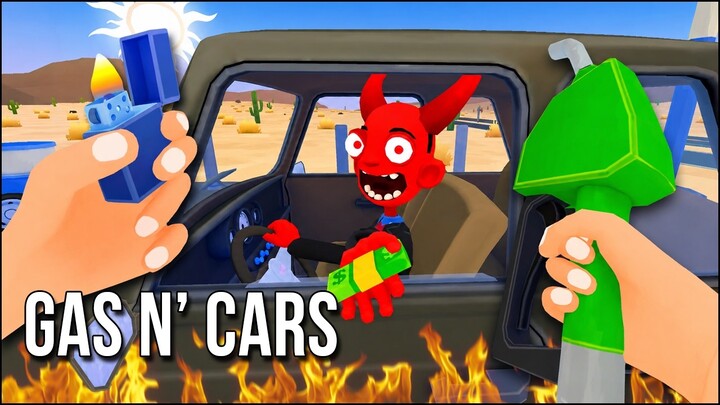
Gas N Cars elevates the arcade-style vehicle simulator genre into a high-stakes tactical exercise by placing resource management and weight transfer physics at the center of its gameplay mechanics. While traditional racing titles focus heavily on cornering lines and apex braking, Gas N Cars introduces an aggressive layer of operational friction: fuel consumption directly dictates physical vehicle handling. As your car burns fuel to maintain high speeds, its overall weight decreases, causing a real-time shift in tire traction, suspension compression, and braking distance. This creates a volatile feedback loop where a driver must constantly adjust their driving style to compensate for a vehicle that becomes faster yet inherently more unstable with every lap.
This article offers an in-depth mechanical breakdown of this specific dynamic in Gas N Cars. We will examine how the interplay between fuel depletion rates, weight transfer variables, and pit stop strategies dictates match outcomes across a standard race weekend. By deconstructing the physics of throttle conservation, draft physics, pit lane logistics, and tire wear compensation, we uncover the structural strategies required to master Gas N Cars at a competitive level.

1. The Fuel-Weight Feedback Loop: Understanding the Physics Engine
The core structural framework of Gas N Cars rests on a continuous dynamic weight equation. Unlike racing games where vehicle mass remains static from start to finish, Gas N Cars treats your fuel tank as a massive liquid counterweight. A full tank of fuel adds substantial mass to the rear or center chassis, pressing the tires into the asphalt to maximize mechanical grip. This additional mass provides high stability during high-speed cornering, but it severely penalizes initial acceleration and increases overall braking distance.
As the fuel tank drains over consecutive laps, the physical attributes of the vehicle undergo a dramatic real-time transformation. The reduction in mass improves power-to-weight ratios, yielding faster straight-line top speeds and sharper turn-in responsiveness. However, this weight reduction also decreases downforce on the rear axle, making the vehicle increasingly twitchy and prone to sudden oversteer. Drivers must recognize that the braking point used on lap one with a full fuel load will be completely inefficient by lap ten, requiring constant mental recalibration of braking markers.
2. Early-Race Strategy: Managing Heavy Chassis Understeer on Staggered Grids
During the opening laps of a race, drivers face the maximum weight threshold of their vehicles. Navigating a heavy chassis through crowded start grids requires extreme discipline, as the additional fuel mass amplifies inertia. Attempting to dive aggressively into turn one with a full tank often leads to severe front-end understeer, causing the vehicle to slide wide off the racing line and risk catastrophic multi-car collisions.
Heavy Chassis Survival Protocol:
- Early Braking Alignment: Extend your braking zone by 15-20% during the first three laps to account for increased momentum.
- Trail-Braking Modulation: Maintain light brake pressure toward the apex to keep weight transferred onto the front tires, forcing the front end to bite into the turn.
- Smooth Throttle Application: Avoid snapping the throttle open at corner exit; heavy fuel loads make sudden weight transfers to the rear chassis unpredictable.
By prioritizing vehicle preservation and line positioning during this heavy phase, you avoid unnecessary tire scrubbing and set up a clean baseline for the mid-race acceleration window.
3. The Slipstream Economy: Weaponizing Drafting for Fuel Preservation
As the race settles into its mid-game rhythm, energy conservation becomes as critical as raw lap times. In Gas N Cars, drafting behind a rival vehicle does not merely grant a top-speed draft boost; it drastically reduces aerodynamic drag, allowing your engine to maintain high velocities at partial throttle inputs. This mechanical reality transforms the slipstream into a vital fuel-saving tool.
Tucking directly into the low-pressure pocket behind a lead car reduces engine load significantly. By lifting off the accelerator earlier into braking zones and coasting within the draft, drivers can cut their fuel consumption rate by up to 25% over a stint. This enables a driver to match the pace of the leader while burning far less fuel, effectively extending their stint length and unlocking flexible pit stop windows that can win the race on strategy alone.
4. The Mid-Stint Pivot Point: Adapting to the Snap-Oversteer Horizon
Midway through a race stint, the fuel tank hits a critical threshold—typically around 50% capacity—where the vehicle's handling characteristics invert. The heavy understeer that dominated the opening laps evaporates, replaced by a highly neutral balance that rapidly shifts toward twitchy oversteer. This transition zone is where many intermediate drivers lose control and spin out.
Managing this transition requires modifying steering inputs from long, sweeping sweeps to crisp, rapid corrections. As the rear end grows lighter, applying heavy throttle out of slow corners will easily break rear-tire traction. Drivers must exercise progressive throttle control, feeding power smoothly to keep the lightened rear suspension settled over rumble strips and elevation changes.
5. Tire Wear Compound Physics: The Dual-Variable Decay Model
Fuel depletion does not occur in a vacuum; it directly interacts with the game's complex tire degradation physics. Gas N Cars features a dual-variable decay model where tire compound temperature and surface wear degrade alongside fuel mass reduction. Interestingly, as the car grows lighter from fuel burn, tire wear per lap actually decreases due to reduced cornering loads—provided the driver avoids wheelspin.
Tire-Fuel Interaction Metrics:
- The Heavy-Scrub Phase: High fuel loads generate extreme tire heat in fast corners, accelerating rubber degradation if aggressive steering angles are forced.
- The Thermal Equilibrium: As fuel burns off, tire temperatures stabilize, creating a sweet spot where grip and vehicle lightness produce peak session lap times.
- The Rubber Breakdown: If rear tires are spun during the light-chassis phase, the loss of rubber compound combines with the light rear weight to create an uncontrollable handling profile.

6. The Pit Stop Dilemma: Calculating Fuel Volume vs. Track Position
The pit stop interface in Gas N Cars is a cold exercise in mathematical balance. When pulling into the pit box, the game allows players to precisely meter the amount of fuel added to the tank. Refueling is calculated on a per-liter time cost; every extra gallon added increases the duration of your pit stop, costing valuable seconds of track position.
Deciding whether to take a full tank or a partial fill depends entirely on traffic and remaining lap counts. Taking a full load grants maximum range for the final stint, but it drops your car back into dense traffic with a heavy, slow vehicle. Opting for a short-fill reduces pit stop time, allowing you to leapfrog rivals via the "undercut," but forces you to handle a second pit stop or engage in extreme fuel saving before the checkered flag.
7. Advanced Lift-and-Coast Tactics: Extending Stints Under Fuel Pressure
When a driver finds themselves several liters short of finishing the race without an extra pit stop, they must deploy the advanced technique known as "Lift-and-Coast." This method involves lifting off the accelerator 100 to 200 meters before the actual braking point, allowing aerodynamic drag to naturally slow the vehicle before applying the brakes.
Because an engine consumes maximum fuel under wide-open throttle at high RPMs, cutting the throttle early at the end of long straights yields massive fuel savings with minimal lap time loss. By coasting into braking zones and carrying higher rolling speeds through the corner center, a skilled driver can save enough fuel over a five-lap stretch to eliminate the need for a splash-and-dash pit stop, securing victory over faster rivals who are forced to pit.
8. Weight Transfer Inversion: Navigating High-Speed Chicanes on Low Tank Volume
High-speed chicanes present the ultimate test of vehicle control during the closing laps of a race. With the fuel tank nearly empty, the vehicle reaches its absolute lowest mass rating. While this allows for lightning-fast direction changes, it also removes the stabilizing inertia that holds the chassis steady over high kerbs.
When clipping kerbs with a lightweight chassis, the suspension rebounds violently. Without the dampening weight of a full fuel load, the car can easily be launched into the air or thrown into an unrecoverable tank-slapper. Drivers must approach chicanes on low fuel with precise, subtle wheel inputs, avoiding aggressive kerb strikes and keeping the chassis as flat as possible to maintain continuous tire contact with the tarmac.
9. The Sprint Finish: Harnessing Maximum Power-to-Weight in the Final Laps
The final three laps of a Gas N Cars event represent the absolute peak of vehicle performance. With the fuel tank running on fumes, the car boasts its highest power-to-weight ratio of the entire race. Top speeds on long straights reach their absolute maximum, and braking distances shrink to their shortest lengths.
This sprint finish demands an aggressive, qualifying-style driving mindset. Drivers can attack corners with immense entry speed, trusting the lightweight chassis to rotate quickly toward the exit apex. However, the margin for error is microscopic; a single moment of lock-up or excessive wheelspin will instantly snap the rear end around, destroying a race's worth of strategic calculation just meters from the finish line.
10. Mechanical Failure Risks: Managing Engine Temps and Fuel Starvation
The final hazard lurking in the fuel management equation of Gas N Cars is the threat of mechanical failure. Running an engine on an extremely low fuel level introduces the risk of fuel starvation during high-G cornering. When taking long, sweeping turns with less than two liters in the tank, fuel sloshes away from the pickup pump, causing engine misfires and temporary power loss.
Furthermore, aggressive lean-fuel running increases internal engine temperatures. If a driver pushes the engine too hard while drafting or running low fuel mixtures without adequate cool air, the radiator can overheat, causing permanent horsepower degradation. Managing ambient engine temperatures through gear short-shifting and avoiding prolonged rev-limiter bouncing ensures that your vehicle makes it across the finish line with its mechanical integrity intact.
Conclusion
Gas N Cars succeeds by turning the physical laws of fuel depletion and weight transfer into a thrilling, deeply tactical racing framework. Mastery of the game requires far more than quick reflexes and a sharp racing eye; it demands that drivers act as real-time race engineers, constantly calculating fuel consumption rates, adjusting braking markers, and adapting to a shifting weight distribution. Every lap presents a brand-new mechanical challenge as your vehicle transitions from a heavy, understeering cruiser into a featherweight, oversteering rocket. By respecting the thermodynamics of racing—balancing draft efficiency, tire degradation, and pit stop logistics—you elevate your driving strategy from simple lap-time hunting to a masterclass in motorsport management.